
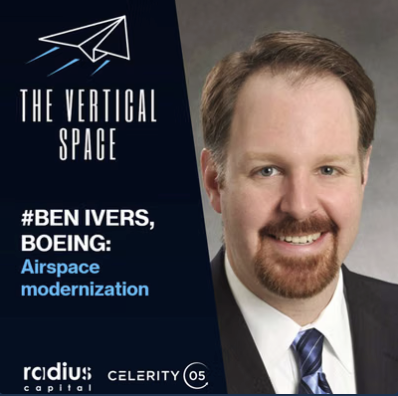
#105 Ben Ivers, Boeing: Airspace modernization
In this episode of The Vertical Space, Ben Ivers — Boeing's Director of Emerging Technologies and Regulatory Strategy — unpacks a deceptively simple idea: airspace modernization is no longer optional, and the technology to enable Automated Flight Rules is largely ready today. The hard part, he argues, is not the technology. It is introducing a new flight mode alongside VFR and IFR that can scale drones, eVTOLs, and future autonomous operations without turning the sky into sanitized corridors reserved for new entrants.
Ben explains why Boeing thinks in decades rather than quarters, how Automated Flight Rules differ from UTM, and where the real bottlenecks lie: reliable communications, latency, surveillance, micro-weather, and certified digital services. The conversation also covers the ICAO Advanced Air Mobility Study Group, what an additive modernization roadmap looks like, and why Boeing sees this as a company-wide obligation rather than just a regulatory exercise.
Key Topics
- Why Automated Flight Rules technology is ready today and what is actually holding back implementation
- How AFR differs from UTM and U-Space — and why the distinction matters for scaling the airspace
- Why Boeing argues AFR should be available to all aircraft, not just new entrants
- Lessons from IFR development for introducing a new flight mode into the NAS
- Boeing's role at ICAO's Advanced Air Mobility Study Group and what the international roadmap looks like
- The real bottlenecks to airspace modernization: communications latency, surveillance, micro-weather, and certified digital services
- Before and after scenarios across GA, airlines, drones, and urban air mobility under an AFR framework
- Why Boeing thinks in decades and what obligation that creates for shaping the future airspace now
+ Read Full Transcript
Ben Ivers: Playing a role in helping to orchestrate that in a thoughtful, meaningful, safe, innovative, and efficient manner is extremely important. Boeing has the luxury of operating in an environment that is unique — it isn't like the cell phone industry where the cycles are very rapid. We have an obligation to think very long term. We get to think in terms of decades as opposed to days or weeks or months. That is both exciting and humbling and a responsibility that we take seriously.
Jim: Hey, welcome back to The Vertical Space. Today we welcome Ben Ivers from Boeing — Director of Emerging Technologies and Regulatory Strategies, leading enterprise-wide safety, regulatory affairs, strategy, and advocacy for Advanced Air Mobility, UAS, autonomous systems, AI, regulatory innovation, and global mandates. Ben serves as Chair of the AUVSI Air Advocacy Committee, Chair of the AIA Emerging Technologies Committee, Chair of the ICCAIA Advanced Air Mobility Working Group, and Treasurer of the Royal Aeronautical Society.
Jim: What's something that very few in the industry agree with you on?
Ben Ivers: Airspace modernization is critical to the future of aviation. The technology is ready now for a potentially new fit-for-use Automated Flight Rules that could enable increased operational efficiency, safety, and enable new entrants. As the airspace gets more and more complex and more users are taking full advantage of it, a new flight mode is going to be required and the technology is available. Now the need is to get that technology ready and implemented and worked out through a concept of operations.
Luka: What's contrarian or the most controversial about this point of view?
Ben Ivers: It's been many years since we've seen any changes in how we operate aircraft. Visual flight rules and instrument flight rules have been around for many years. Creating a new flight mode in and of itself is very challenging, and it creates a lot of questions that need to be answered. The question becomes whether or not this would be a flight mode available for everybody to use. We believe at Boeing that it can and should be used by any and all aircraft capable of operating in that mode — whether it's an aircraft with a pilot on board, an uncrewed aircraft, a general aviation airplane, or a large aircraft that flies commercially.
Luka: Are there any lessons from when instrument flight rules were developed?
Ben Ivers: It was driven by both safety and technology. IFR was largely enabled by things like radar and other communication technologies as well as onboard technologies that would enable an aircraft to operate in instrument meteorological conditions. The ability for air traffic controllers to vector airplanes and make sure separation is maintained. That level of layered approach creates a very safe structure. Automated Flight Rules creates a new capability that allows for more of that automation to take over — allowing an airplane to fly with a pilot or autonomously and rely on that technology to maintain safe separation, reducing pilot workload, reducing air traffic controller workload, allowing those aircraft to operate in day conditions, night conditions, seamlessly alongside VFR and IFR procedures.
Role at Boeing and Industry Insights
Jim: Tell us a little about your role at Boeing and your work with ICAO.
Ben Ivers: I lead the emerging technologies and regulatory strategy portfolio of Boeing. We support companies like Wisk — Boeing's subsidiary working on a four-passenger autonomous air taxi — as well as SkyGrid who are aiming to open the airspace for all UAS. We have platforms ranging from defense to civil and public use aircraft. I'm also the member for ICCAIA at ICAO — the International Coordination Council for Aerospace Industry Associations, the international body that enables industry companies to participate in ICAO processes. I'm the member for the Advanced Air Mobility Study Group, representing industry. That group is focused on creating a holistic vision involving all different types of new entrant aircraft — eVTOLs, drones, fixed-wing autonomous aircraft, and highly automated aircraft — and understanding how those are all going to fit together and what enabling technologies are going to turn that into an operational concept that will work worldwide. The plan is to develop the holistic vision that will chart the course for other study groups and expert bodies at ICAO, making a series of recommendations that would drive future ICAO work — standards and recommended practices, guidance material — that will work their way to individual states for adoption.
Jim: Let's say Boeing's CEO wandered into your office and said, "Why are you here and what difference will your office make to the future of Boeing?"
Ben Ivers: The work Boeing is doing right now with regards to creating new capabilities, new aircraft, new concepts, is really important to both our own future and ensuring that we have the right technologies and framework to operate from. But we also need to help create an environment that is expandable and scalable. We need to create an airspace that has the wherewithal from both safety and capacity perspectives to enable these new aircraft as well as further aircraft to be introduced. The environment we work within is quickly becoming very saturated — a lot of new airplanes from drones to eVTOLs. Boeing is in a perfect position to help chart that course, set forward a vision for what that future will look like, drive research, technology development, and concept evaluation. One of those ways is with Automated Flight Rules — creating a new mode of operation that leverages the current technology available as well as emerging technology to create capacity and safe operating conditions and make room for all aircraft to enter the airspace safely and efficiently.
Jim: Some of this sounds familiar to what Boeing did 20-plus years ago. Give a perspective on what was going on then versus today.
Ben Ivers: That air traffic management effort was aimed at creating enabling technology to help transform the airspace — that's where there's maybe some commonality. What's different today is Boeing recognizes we aren't going to build those systems necessarily. There are many players that build those ground-based systems. What we see is that the technology is ready to enable air traffic modernization. It's important that governments work with them to integrate those technologies into the overall ecosystem and understand how they work together. As we do that, we're going to learn and evolve this vision together as an industry. That's the unique perspective Boeing brings — very different from the Boeing Air Traffic Management days.
Biggest Misconceptions Around Automated Flight Rules
Luka: What do you believe is the single biggest misconception that the broader aerospace community still holds?
Ben Ivers: The biggest misconception is that automated flight rules are only being developed for new entrant aircraft. There are many papers describing how elements of these rules could play a role in helping drones or eVTOLs integrate into corridors around cities. We see it differently — you can take these same technologies and enable operations in any form of airspace. One of our pilots asked a great question: could I take my 747 and fly in a corridor? Everybody immediately said that probably doesn't make sense. But then as we thought about it, we were thinking about this in a constrained environment. Go beyond the concept of sanitizing airspace and only allowing aircraft that cooperate in that AFR mode. Could you enable AFR in class G, class Echo, class Alpha, class Bravo airspace? That unlocks something very valuable — it becomes an additive component rather than exclusionary, and reduces workload for pilots and controllers.
AFR Summarized
Luka: Is it a good summary that AFR is about getting the flexibility of VFR with the efficiency and safety of IFR flights?
Ben Ivers: At its core, AFR is about the automation of conflict management, which will optimize traffic flow, reduce controller and pilot workload, and enable new entrants. The capability will be driven from digital information, cooperative practices, and automated data exchanges. Think of technologies like flight and mission management capabilities, increased navigation and surveillance performance, and detect-and-avoid systems that add layers to the already robust system of maintaining separation. A controller recognizes what an aircraft can do and trust is built as a result. If you take that and extrapolate it to a broader set of airspace with more elaborate procedures and take advantage of new digital infrastructure, you can turn on a much more automated approach to managing traffic.
Difference Between AFR and UTM
Luka: There's a lot of overlap between AFR and UTM/U-Space. What is the overlap and are those two ecosystems collaborating?
Ben Ivers: They are collaborating. What you're seeing in UTM/U-Space environments is the crawl before a walk before a run — taking automated conflict management and extrapolating it to a much broader airspace. When you create a UTM environment, you're effectively sanitizing it — everyone has to cooperate according to a common set of rules. The challenge and opportunity that AFR presents is to do that in a mixed environment where aircraft of all different types are operating — VFR traffic, AFR traffic, IFR traffic, different speeds, altitudes, missions, all intermixing. The ability to see all of that and manage it through digital means and put that information into the hands of pilots, ground station operators, and controllers — that creates the trust in the system to enable a mixed operation. AFR is more machine guidance than machine decision making. We're not talking about an all-seeing eye in the sky or an AI that controls everything. It's a broad data exchange and information exchange enabled by new technologies that can enable pilots and controllers to all see the same thing and operate off the same common operating picture.
The Before and After of AFR
Jim: Take our audience through the before and after of the integrated aerospace and automated flight rules.
Ben Ivers: For a GA pilot today: you can take off on a clear day, fly the route you prefer, have visibility of other aircraft on your tablet, execute a procedure. You may be limited to where you can do that procedure and how far you can go. After AFR: you may be able to file that flight plan, go a little further, fly at a slightly different altitude — one that might be more preferred. You might be able to mix with other types of traffic. For a commercial jetliner today: you may be restricted to pre-established tracks. In an AFR world, you may be able to take a completely different route, shaving off an hour or more off a long flight. Reduced fuel burn, improved on-time performance, potentially more safe environment — a controller doesn't have to pay as close attention to your operation. For the drone or eVTOL space: current limitations of 400 feet may evolve. In an AFR-type construct, you could have aircraft operating without creating an undue burden on the air traffic management system. For eVTOL, creating an AFR regime would allow those aircraft to operate at more reduced separation at higher tempo. I've got about a 45-minute to an hour commute every day. The ability to do that in maybe 10 or 15 minutes is significant.
AFR Success Metrics
Luka: When assessing progress towards airspace automation or AFR, what metrics do you track most closely?
Ben Ivers: Probably the biggest thing is the communication aspect of the system — making sure the data flows from ground segment components, weather, radar systems to the aircraft, to the ground station operator, to air traffic controllers. Having that information common and shared amongst everybody is important. It needs to be accurate, from the right places, with the right latency, in the hands of the right humans at the right times. There are different types of communication mechanisms — VHF voice, digital communications, datacom. The ability to leverage that will go a long way towards making sure AFR can achieve reality.
Economic Opportunities in Digitized Airspace
Luka: How do you expect companies to make money from a digitized airspace, and how will the existing value chain be impacted?
Ben Ivers: There will definitely be opportunities for new players. We're already seeing various companies activate as UTM service providers. Companies can play this role — whether they offer those services or an air navigation service provider contracts with them is a decision that needs to be made region by region. The other big opportunity is just the increased number of aircraft it could enable — the increased number of safe operations, increased tempo. Companies building commercial jetliners, GA aircraft, drones, eVTOLs — all have the ability to create more aircraft, more ground stations, more air-ground interfaces. The companies that support logistics of cargo and people all play a role. The simplest way to think about it: it grows the overall aviation ecosystem pie. Instead of creating a bigger slice for one particular group, it grows the overall pie so there's opportunity for all current players and potentially new players.
Ben Ivers: Boeing sees this as an opportunity to ensure that our current airspace evolves in a way that supports safe operation and growth globally. Increasing strain on the airspace can create safety risks. We see the opportunity to potentially alleviate some of those safety risks by creating new modes that would enable current and new operations to work more seamlessly. The potential benefits support the whole globe, but we see this very much as meeting the current and future challenges.
Challenges and Future of Automated Flight Rules
Ben Ivers: The contrarian view: some say why can't we just modify current flight rule regimes to support these operations? We don't want to get into a situation where those operations are precluded — where certain aircraft or communities can't meet the requirements of carrying additional equipage. We don't want to create an airspace that begins to exclude certain groups. By creating a new flight mode, when equipped appropriately, when planned for appropriately, when managed appropriately, one can execute to. Say you're going to fly an IFR flight route the same way you do it today — you can. But if you have the right equipage on your aircraft and the air navigation service provider and a third-party service provider provide the right data, you can operate a little more efficiently and a little bit more safely under an AFR regime. Both can operate at the same time and see each other and manage the risks accordingly. That's the benefit — additive rather than exclusionary.
Luka: What's a realistic timeline for a major airspace jurisdiction to achieve these new automated flight rules?
Ben Ivers: It's the million-dollar question. It's going to be a real challenge to determine the speed at which it can go. Maybe it's sometime in the middle of this century. It will depend greatly on how quickly we think we can do the work together. This is a call to action — we need industry and government agencies to start thinking about this now, taking action, doing the research, building plans to demonstrate this capability. If we don't start now, it'll forever be in the future.
Boeing's Obligation to Look to the Future
Jim: Why would Boeing spend time on this right now when near-term shareholder return is so important?
Ben Ivers: Boeing has always looked to the future. Most commercial airplanes are designed to last for 30 years. As we think about current and future commercial airplanes, we're looking 40, 50, 60, 70 years down the line. Playing a role in helping to orchestrate that in a thoughtful, meaningful, safe, innovative, and efficient manner is extremely important. Boeing has the luxury of operating in an environment where we get to think in terms of decades rather than days or weeks or months. That is both exciting and humbling and a responsibility that we take seriously.
Jim: How important is what you're doing for the success of Wisk?
Ben Ivers: Wisk's initial operations do not depend on Automated Flight Rules to see the light of day. They have plans to develop their aircraft to operate within instrument flight rule mode with waivers and exemptions. None of what we're talking about in AFR is absolutely required for these aircraft to fly. When we talk about AFR, what we're talking about is the ability for aircraft like Wisk, other eVTOLs, commercial aircraft, GA, drones — to scale up in a safe and efficient manner and provide more opportunity for those aircraft to fly. It's not a near-term need. It's a long-term imperative.
Luka: What big bet is Boeing making that is critically important?
Ben Ivers: It's not one piece of technology — it's a combination of things. Automation and autonomy have an important role to play in the future of civil aviation. We're taking a very deliberative approach. We want to protect human life and ensure the safety of our products. The air traffic management system, the air navigation service provider world — it's becoming increasingly digital. Still a lot of roots in the past with analog systems and paper processes becoming more and more digital. Think of quantum computing and other capabilities that have a lot of promise for faster information flow and processing. These technologies roll together and create new opportunities. What's the equivalent of the fly-by-wire bet? I would say the biggest and most important element is going to be how we approach automation — both onboard the aircraft and within the ecosystem. With Wisk, we are exploring what it means to have a remotely supervised aircraft fly. Those technologies have an opportunity to dramatically improve how our aircraft currently work, close safety-challenging areas, improve runway operations, improve operations in the air, eliminate risk that currently exists. The development of that level of automation and capability is going to be important to ensure we have a product that meets the market's need.
Jim: What kinds of companies will most benefit, or what kinds of technologies are needed that you would say, work on these and you'll do well?
Ben Ivers: Whatever your interest level is, please start with safety. New types of digital services can be created — for air navigation service providers, for airlines' operations, for airports, vertiports, other ground-based players. The ability to provide those services, to build the digital backbone, to help integrate those technologies together, working with government and non-government agencies and with ICAO to ensure the technologies come to fruition and work seamlessly together — that's really important.
Ben Ivers: Airspace modernization is critical and without it we're going to be challenged to meet the growing demand for goods and passenger travel. The technologies needed for Automated Flight Rules are ready now. They are mostly mature and all that needs to happen is the industry to work with governments, to work with other organizations, to do research and integrate those capabilities together to make this future a reality.
