
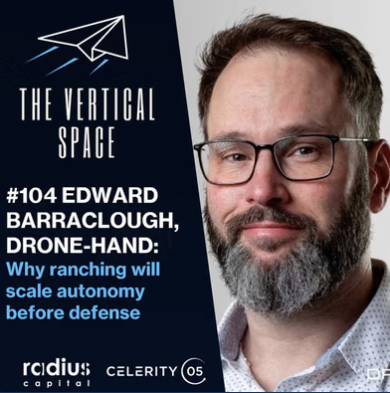
#104 Edward Barraclough, Drone-Hand: Why ranching will scale autonomy before defense
In this episode of The Vertical Space, Edward Barraclough — founder and CEO of Drone-Hand — makes a contrarian argument: agriculture, not defense or urban air mobility, will be the first environment where autonomous UAVs reach true commercial scale. The reason is straightforward. Ranching offers massive land areas, repetitive tasks, severe labor shortages, permissive operating environments, and ROI that is measured in days rather than years.
The conversation covers how drones are already replacing helicopters on million-acre cattle stations in Australia, why biological data creates one of the deepest moats in autonomy, how to build trust with producers who have seen ten years of technology promises fail to deliver, and how CASA's regulatory evolution compares to the FAA and EASA. It is a rare look at autonomy where economics, biology, and geography collide in ways that most of the industry has overlooked.
Key Topics
- Why agriculture will achieve commercial-scale autonomous UAV operations before defense or urban air mobility
- How drones are already replacing helicopters on million-acre cattle stations in Australia and New Zealand
- Why ranching is the perfect proving ground for autonomy — and how it maps to defense applications
- What changed in the last few years to finally make drone adoption viable in agriculture after a decade of failed promises
- Why biological data creates one of the deepest competitive moats in the autonomy industry
- How to build trust with producers who measure everything in immediate, tangible ROI
- The role of synthetic data in training autonomous systems for livestock operations
- How CASA's regulatory approach to drone operations compares with the FAA and EASA
+ Read Full Transcript
Edward Barraclough: The reality is agriculture is one of the fastest adopters of technology out there. They just have to see the ROI. They just have to see that it is going to improve things for them in some manner — whether it's actual cash ROI or time or efficiency or long-term gains. They need to see that immediately.
Luka: Today we're joined by Edward Barraclough, founder and CEO of Drone-Hand, a company using autonomous drones and edge compute AI to transform livestock operations. Edward brings a contrarian view that agriculture — not defense or urban air mobility — will be the first environment where autonomy reaches true commercial scale. We explore why ranching might be the perfect proving ground for autonomy, how drones are already replacing helicopters on million-acre cattle stations, and what real ROI and trust look like for producers who are just trying to survive the season.
Luka: Is there anything that very few in the industry agree with you on?
Edward Barraclough: Agriculture, not defense or urban air mobility, will be the first true at-scale autonomous UAV success story. Agriculture has all the ingredients to make autonomy commercially viable right now — huge land areas, repetitive tasks, a major labor shortage, and environments that actually benefit from autonomy rather than resist it. The economics are clearer than almost anywhere else. You're not flying over cities. The regulatory burden is lower. Defense and UAM will eventually scale, but they face far more regulatory, safety, infrastructure, and public acceptance barriers. Agriculture has the demand, the economics, and the operating environment.
Luka: How do you compare and contrast that to agriculture, given the defense market is where these technologies are being developed and matured and there's a lot of capital behind it?
Edward Barraclough: You can't deny the funding behind the military — that's 100%. But you are limited by where and how you can test. In defense you have to have very specific environments. Whereas with agriculture, there are literally millions of square hectares of land that can be tested on with little to no risk to humans on the ground or in the air. Agriculture can be like the perfect proving ground for things like defense — tested in agriculture first where it's not going to face regulatory barriers around human welfare, and then translate those systems into defense. Identifying animals is not that different to identifying enemy combatants. If you can prove it on an animal first, you can then use it in a defense standpoint.
Peter: Agriculture has a big and valuable use case right now. Defense is such a different animal — different economics, use cases are an absolute moving target because the tactics are changing every few weeks. Whereas in ranching, the ultimate mission the systems would fly is out there and is a relatively stable set of requirements. It's just a question of when the underlying technology became good enough to serve that mission.
Edward Barraclough: That stability and that difference allows for it to become one of the first truly at-scale success stories in autonomous UAVs.
Adoption of Automation in Agriculture — Past and Present
Peter: People have been talking about using drones in agriculture for about 10 years. For 10 years there was hope and promise and a lot of talk, but when you actually talked to end users, they weren't getting 100% of what they needed. Things have really changed now — how do you explain that?
Edward Barraclough: A really common issue with any technological solution provider in the agriculture space is not addressing pain points directly — coming out with cool new tech and saying "this will make things better for you" when the user is saying "I don't really have that problem." What we're seeing today is that far more innovators are listening to the users themselves and building or adjusting their technologies to suit what's actually needed on the ground. It's that chicken-and-egg thing: here's this cool thing, but if you don't have anyone who needs it, it's not going to take off. On top of that, drones have become cheaper and higher quality. The technologies are better, cameras are better. People are becoming more and more exposed to drones, robotics, and autonomy. You can go to your tractor dealership now and have tractors already set up for GPS. The idea of autonomous systems is no longer science fiction. The reality is agriculture is one of the fastest adopters of technology — they just have to see the ROI.
Peter: The technology not only needed to mature in an absolute sense, but it needed to be around long enough for the practitioners in agriculture themselves to develop the technology into a way that they would really understand in terms of how it's employed. Rather than Silicon Valley coming to the rescue and telling the agriculture industry how to change the way they work — which obviously failed over the last 10 years — it really takes the practitioners themselves harnessing the technology in the ways they know best because they understand the complexity of the biological systems at hand.
Edward Barraclough: A hundred percent. A lot of this comes back to the ideas of collaboration — getting out of that space of "we produce this technology, you are going to use it," and into "let's all work together to make or refine the technology to suit the industry's needs." This collaboration is everywhere — not just tech providers and farmers and producers, but investors, industry bodies, and government. Swan Farm Robotics just announced they've done over 10 million hectares from their robotic tractors. This type of thing is being adopted so quickly. This also plays into the stereotypes of the agricultural industry — oh no, they're too conservative. The reality is agriculture is one of the fastest adopters. They just have to see the ROI immediately.
The Case for Autonomy in Agriculture
Jim: About 10 years ago there was a study that talked about agriculture as one of the best use cases for automation. Why was agriculture considered such a great use case, and give us the before and after — the cost before and after aerial automation?
Edward Barraclough: It really comes down to efficiency and time savings. In Australia, properties in the Northern Territory can be more than a million hectares for one ranch. The large majority of people would use helicopters — Robinson R22s, light aircraft. This was great post-Vietnam War when people were coming back with pilot skills. But now labor shortages are increasing, fewer people going into the ag space, the cost of keeping those Robinsons running is going through the roof, and there's been high-profile legal cases about keeping those helicopters compliant. A cattle station we've been working with — about 200,000 acres — uses helicopters twice a year to check and muster cattle, spending anywhere between $60,000 to $100,000 each time. That's $120,000 to $200,000-plus a year just on finding and moving some animals. Bring in a fixed-wing VTOL drone that can fly for 3, 4, 8 hours — even just to check if there's water in the dams and troughs, where the animals are, and then add autonomous herding or flight missions to check these things. Suddenly you're potentially saving hundreds of thousands of dollars a year. A few months ago, one of Australia's biggest beef agribusinesses lost around 1,500 cattle that died because the water was not turned on for one of their troughs. Send the drone out once a week — you'll never have that issue.
Introducing Drone-Hand
Luka: Give a quick overview of what you're doing at Drone-Hand.
Edward Barraclough: At Drone-Hand we are redefining livestock management through AI-driven drones and fixed cameras to increase efficiency, reduce labor use, and reduce preventable livestock mortality. We've built this in a scalable and flexible way so we can move beyond agriculture. For a smaller property owner, they might use an enterprise quadcopter with our software as an app to the controller. They define their paddocks, take the drone out, choose Paddock 1, choose subjects — cattle, sheep, water sources, pasture — and press go. The drone flies itself in a semi-autonomous manner and in real time the machine learning algorithms tell the farmer where the livestock are, if any are in trouble, and give an accurate count. Most importantly, offline — it doesn't use cloud processing but uses the actual remote controller to process. At the end you get a report you can use for compliance, animal husbandry planning, tax purposes, insurance. We cover the entire sector of the livestock industry from quadcopters to fixed-wing VTOLs to fixed cameras.
Livestock Ranching Use Cases
Jim: What's novel about what you're doing? What's the AI component?
Edward Barraclough: Most drone use in agriculture previously was post-processed — the drone would be a data capture device, you bring it back, put it through the computer, get the results. That's not good for livestock when animals move around. What we're doing differently is processing the imagery and data in the actual controlling device. In a quadcopter, as an app in the remote controller. In long-range fixed-wing VTOLs, we've got onboard edge compute — Nvidia Jetson products in the drones themselves or on the ground station. This takes away the need for internet access. In rural areas, Starlink is back in the house — it's not necessarily out in the paddocks. It allows for real-time actionable information. You can know right now what's happening, as opposed to collecting data and finding out an hour later.
Jim: How would you reduce that livestock mortality rate?
Edward Barraclough: Simply by having more information, by knowing what's going on out there. A cow will leave its calf and walk away from it. The calf dies of dehydration. By having information daily or every couple of days, you can know what's happening and get out there to address it before the animal passes. The same translates to disease — if you can see animal behavior indicating disease, you can address it while it's still able to be treated. The livestock industry in Australia loses over $4 billion a year to preventable livestock mortality. If we can reduce that by a fraction, you're saving a huge amount of money.
What the End User Really Cares About
Edward Barraclough: Agriculture producers are not trying to try something exciting and new. What they're really trying to do is survive a season. They're looking for tools that can save them time and money today. If it does that, they'll adopt it today. Most farmers and ranchers are operating on debt — they'll take loan facilities with the assumption they'll get it back at harvest or at sale. With the increase in extreme climate events, those good years are happening fewer and fewer and it's getting harder and harder to make it through. If we can find tools to make that happen easier and more efficiently, they'll be adopted.
How Regional Differences Impact the Product
Jim: Do you need to learn anything about different locations before you deploy? Is there a data set you need to adapt to?
Edward Barraclough: Every time we move into a new area, we have to be prepared to be flexible, to refine, to adapt, and in some cases build new elements to those data sets because of the sheer amount of variance. We did trials in New Zealand on the South Island where farms change altitude from 1,000 meters and below in just the one paddock — quite an adjustment for mission planning parameters. Even soil color throws off the machine learning and image recognition. I was chatting with guys from Montana two days ago — is it going to work with mountain sheep in the snow? My answer was, let's find out. We've reduced this data collection to functioning, integrated model to weeks instead of months, sometimes faster. This has come from scaling, experience, and time within this industry.
Luka: Would you say this variability is the single hardest generalizable problem in deploying autonomy across different geographies?
Edward Barraclough: A hundred percent. Wildly different terrain, vegetation density, livestock behavior, connectivity issues, soil color, snow cover, grass cover. Even animal behavior — cattle in the Northern Territory see people maybe once or twice a year and can be very skittish. Cattle on a dairy are like your house pet. You have to be ready to adapt. There's no way to generalize one system to work on all.
The Role of Synthetic Data in Agriculture
Luka: How much do you rely on synthetic data, and is my intuition correct that unlike in other autonomy use cases where you can simulate physics, you can't easily simulate biological behavior?
Edward Barraclough: Synthetic data could work a lot faster — you can gather a lot more information a lot faster. But you're never going to get those natural variances in behavior, animal to animal, property to property. We just got an approval last week for an upcoming development project where we're actually going to be competing with one of the biggest names in generated AI — both creating a disease-detecting machine learning model concurrently to see which produces the most accurate results. I believe real-world data will win out because you can't replicate 100% of the variances you see in nature. But time will tell.
Building Trust with Farmers
Luka: What does trust look like on a farm, both from an autonomy angle and a customer relationship angle?
Edward Barraclough: Trust is completely built through repeatability — consistency, consistent results, no surprises, predictable routines. Farmers care about: does it work every time? Can I trust this thing to consistently return accurate results? Does it actually create extra work for me or reduce work? Does it keep my staff and livestock safe? After three or four or ten flights where the system has behaved predictably and produced reliable results in different conditions, that's when we get the trust. More and more innovators are bringing the farmer along on the journey: "We're an early stage startup. Come with us. We can build this thing together." That involves honesty — going to the farmer and saying "Yes, I own that mistake and we are going to fix it." The only way I can know something needs fixing is if you share that feedback with me.
Common Misconceptions About Autonomy in Farming
Luka: What are some common misconceptions farmers have with respect to autonomy?
Edward Barraclough: A lot of expectations around autonomous systems is one of overwhelming complexity. When the average person hears about robotics and autonomous systems, they immediately think of science fiction and things that are going to require a lot of technical knowledge. The reality is with most autonomous systems, they're built to be simpler and easier to use than current systems. It just takes a few times of letting the farmer see that this technology is simple to use and doesn't require them to be trained in mechatronics. For Drone-Hand, we built it with the average user in mind — including my 80-year-old father. If we can make it simple enough that they can just pick it up and understand it within half an hour, we've hit the mark. Any new system being used in an industry needs to be accessible — you need to be able to pick it up and use it straight away. No one wants to be told "here's how to save all this money by using our system, but you're going to have to retrain your staff." That puts people off.
Bottlenecks to Scaling Autonomy in Agriculture
Luka: What are the gating factors for mass adoption?
Edward Barraclough: Regulatory issues in any country are always a problem. In Australia, the changes we've seen over the last couple of years from the way we have to get certified to be a BVLOS operator are very positive. Previously to be BVLOS certified, you'd have to have an instrument rating exam — the same exam for flying manned aircraft outside visual flight rules. That's no longer necessary. It's been simplified to recognize the differences between manned and unmanned aircraft. Broad area approvals are becoming easier and easier. The technical side: edge case handling — how do you deal with large amounts of variability in climate, dust, erratic animal behavior, different soil colors, different weather? These are not the same types of challenges as delivery drones in an urban environment. And of course getting the price down — drone dock systems that were $200,000 a few years ago are now between $10,000 and $15,000.
Luka: Describe the evolution of the Australian regulatory landscape, and compare it to the FAA and EASA.
Edward Barraclough: CASA's regulatory landscape is very much focused around individual risk-based analysis — a SORA-based system where they're looking case by case at the risks involved and the operator's experience and demonstrated history. Previously to be BVLOS certified, you'd have to have an instrument rating exam — the same you'd take for flying manned aircraft. That's no longer necessary. CASA has been moving towards broad area approvals — those who've demonstrated good risk assessment abilities can get approvals much faster. This is in trial and looking like it'll be put into a permanent place in the new year. A lot of regulations, not just in Australia but worldwide, were built for initial urban environment use cases — delivery drones. That doesn't translate well to rural environments where there are no uninvolved bystanders, no crowds. Things like the OONP changes (over near people changes) are fantastic in urban environments but add another level of complexity for livestock operations. A spraying operator in a paddock is not going to need to fly over a crowd of people who haven't given permission — it just doesn't happen out there. This is an evolving situation and I believe these regulatory bodies will gradually evolve more and more understanding.
Luka: Are the regulations in New Zealand similar to those in Australia?
Edward Barraclough: Generally very similar — a lot more similarities between New Zealand and Australia than between Australia and the US or Australia and Europe. They have their own slight differences being a different country, but not a huge amount of difference overall.
The Australian Drone Ecosystem
Luka: When you look at Wing, Manna, and others operating in Australia and elsewhere, where do you place them in terms of collaborators or potential competitors?
Edward Barraclough: The work that groups like Wing have done in Australia has been really useful for operators of any type of UAV autonomous system because it's created understanding of how best to interact with regulations — how to work with CASA as opposed to against them. They've demonstrated lessons around fleet management, safety culture around notifying the public they're flying over, data-driven risk modeling. For our operations, we're not in that type of urban environment, but it still provides great lessons — how do we let neighboring properties know, how do we collaborate with them to maintain that positive relationship between UAVs and the general public. Then there's learning lessons about how to scale a UAV company. We've seen successes and failures, so a lot of lessons to be taken from all of that.
Luka: Adam Woodworth, Wing CEO, explained how the team went into Australia initially because of a clear regulatory pathway. Subsequently the focus shifted to the US. What's your perspective on whether that was driven by economics and market size or saturating that initial regulatory advantage?
Edward Barraclough: I believe it's probably an element of both. From a startup founder perspective, we all look to the US as a much larger economic opportunity. Australia, in many systems, is a great testing ground because of the size difference — smaller population, allowing for a focused trial or test case before taking it across to a much larger market like the US or Asia. Whether or not they reached a saturation point from a regulatory standpoint, I couldn't say. But I would heavily lean towards the economic side. Use Australia as a proof case, scale to the US. It's what we're doing. Build it, scale it here, grow it over there.
Luka: Any other takeaways for the audience?
Edward Barraclough: The opportunities for autonomous systems and UAV systems in general is huge and only going to get bigger. It's really important that all of us as members of this community understand that it's an evolving landscape — everything takes time to grow. In that process there will be ups and downs. But as long as we all remain flexible and adaptable and work together with regulators, with customers, with the general public, we can bring all of this forward to a very successful space. Here at Drone-Hand, that's what we're aiming for in the rural sector, in the livestock production sector — a level of collaboration from government and regulatory standpoint to industry to the users themselves and their neighbors and the general public, to make sure our systems can be widely adopted to have the benefits they can bring.
