
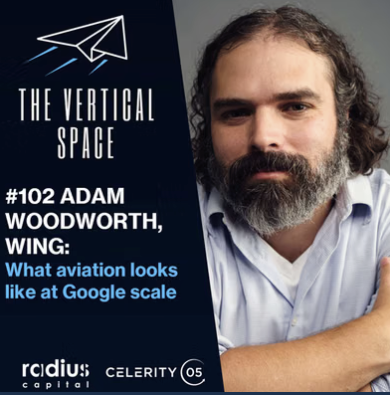
#102 Adam Woodworth, Wing: What aviation looks like at Google scale
In this episode of The Vertical Space, Adam Woodworth — CEO of Wing — makes a case that most people have the risk landscape for drone integration exactly backwards. His argument: the peak of UAS risk in the United States is already in the rearview mirror. Millions of drones flew with almost no regulatory framework and the world kept spinning. Everything since has only added structure. The harder challenge now isn't safety — it's operations, regulatory predictability, and proving that the economics of drone delivery actually work at scale.
Adam traces Wing's full arc — from a hardware engineering job inside Google X in 2014, through the decision to launch real operations in Australia because CASA offered a navigable path, through Part 135 certification, through the DoorDash and Walmart partnerships, and into the current Dallas expansion where Wing is running nearly 2,000 deliveries a day from 20-plus stores. He's direct about what "done" looks like: drone delivery as the default, not the exception — considered in the same breath as UPS and FedEx.
Key Topics
- Why Adam believes the peak risk of UAS integration in the US has already passed — and why almost no one agrees with him
- The math behind drone delivery safety: how Wing validated its probability models through operational data rather than theory
- Why Part 135 air carrier certification — not Part 107 — is the only viable path for commercial drone delivery for compensation beyond line of sight
- How Wing went from one pilot per plane to one pilot per 36 planes, and why getting to one pilot per area is the real commercial unlock
- The coffee revelation: why 80% of Wing's first Australian deliveries were coffee orders, and what that taught the team about consumer behavior
- The Walmart partnership — standardized parking lot infrastructure, copy-paste nest deployment, and what one-plus-one-equals-three looks like in practice
- Why Australia was easier to start in but the US is outpacing it on operational approvals and capability unlocks
- The noise problem: what Wing learned the hard way about hover noise versus overflight noise and why community engagement matters more than decibel levels
- Part 108 — what the rule gets right on intent and where the details fall short, including the TSA cargo screening provisions
- Wing's expansion plan: 100-store rollout with Walmart across Dallas, Charlotte, Tampa, Orlando, Houston, and Atlanta
+ Read Full Transcript
Adam Woodworth: We've had a pretty consistent North Star since the beginning of make delivery ubiquitous, and do it through small flying airplanes. So "done" is: drone delivery is an equal player at the table to all other forms of delivery. And the good but challenging part of that is those delivery volumes have kept going up year over year. So it's a market that's getting bigger and you're sort of tracking it. But yeah, I think that success is, and I tell this to the team frequently, I don't want us to be a great drone delivery company. I want us to be a great delivery company. And be considered in the same breath as the other folks in the space that have been around for a very long time that go and move packages every day. And that implies a certain level of sort of scale across the United States. It requires sort of international scale. And, just generally it's like drone delivery is the default, not the exception when it comes to how you're getting your goods.
Jim: Hey, welcome back everyone to The Vertical Space. It's a special treat to welcome Adam Woodworth to our conversations. As many of you know, Adam is the CEO of Wing. Adam discusses the evolution challenges in the future of drone delivery and UAS integration in the United States and around the world. He highlights Wing's early days and emphasizes the importance of pragmatic frameworks for commercial deployment. Adam details Wing's expansion plans, partnerships with DoorDash and Walmart, and insights from the international operations in Australia and the UK. Our conversation also covers the potential impact of the proposed Part 108 regulations, listen to how Adam projects drone delivery will become a major player in last mile logistics. Adam is the CEO of Wing. He served as Wing CTO from the time of its graduation from X Alphabet's moonshot factory in 2018 and has held a range of engineering leadership roles. With over a decade of experience in the broader aviation industry. Adam is also a passionate model aircraft hobbyist. He studied aerospace engineering at MIT. Adam, thank you for joining us.
Adam Woodworth: Awesome. Thanks for having me. Excited for the conversation.
Jim: Adam, is there anything that very few in the industry agree with you on?
Adam Woodworth: Yeah, I've thought about this one a lot. I think it's something I come back to a lot in industry conversations and policy conversations, sort of all the above. I would assert that we've already passed through the risk peak for UAS integration in the United States. And I think it's one of those things where the idea of drone delivery specifically, but sort of drones for commercial uses, have been around for a very long time, but the actuality of it is only sort of very recent and that's left an immense amount of space for people to dream up all these what ifs. And the reality is that when you actually just go do it, a lot of those what ifs get either disproven or sort of get proven in sort of positive ways. But in terms of the actual airspace management pieces and things like that, when I started at Wing, it was pre Part 107, it was pre walk into a Best Buy, be able to walk out with a product that could go fly more or less autonomously and be used for sort of like recreational video capture. Those markets, that sort of consumer drone as a flying camera market, has already gone through its boom and bust cycle. And it tracks sort of similarly to a lot of other sort of emergent widgets type of technology. Think about action cameras or a new form of sort of audio media or something like that. When the first Mavic came out, it was this magical product. You were like, I can — for the last a hundred years in aviation, it took an immense amount of training and skill and effort and cost to go and sort of operate in the airspace. And even as a lifelong model airplane person, even that you have to build the planes, you have to go find a club, you have to learn how to fly the plane. And suddenly you could walk into a store and walk out with something that just worked. And you didn't have to be an expert about any flying thing. And now you could go exist in the airspace. So in the 2015, 2016, 2017 timeframe, you could go to any park, anywhere in the United States and see people flying stuff around, go to any carnival, any pier, you'd see somebody trying to capture some new picture for Instagram or something like that. And you go to all those places today and you don't see that. And I think it's for a couple of reasons. One, you walk into Best Buy or Target and you put down the better part of a thousand dollars and you come out with this little flying thing, it's cool, it works great, but is the version they release next year better enough that you walk back in and buy another thousand dollar one? If you're not using it professionally, you're just sort of a recreational user of drones. The sort of incremental goodness does not warrant going and getting another one. And at the same time, every state and local town council is starting to be like, hey, it's kind of annoying that we've got all these planes flying around in parks or we had to stop the parade because there's somebody flying around. So you go most parks in the US and there'll be a little sign on all the same park rules and one of them says no drone flying. So you went through this peak of excitement and you can track the registration numbers — millions and millions of new flying things in the airspace. And then since then they've sort of precipitously dropped and you can go look at the sales numbers and all these other different things and it all tracks with that peak. And that peak occurred before any of the rulemaking that we've been talking about was in place. So even it happened, even a lot of it happened before Part 107 was even a thing. So you had probably the most things flying in a completely ad hoc way with relatively little structure around it and the world kept spinning. So it's — I think that you can find a handful of news articles of things where people did stuff they weren't supposed to with these things, but it wasn't, there was no cataclysmic thing that occurred. And now today that tide has receded. So when I think about the future, and I think about the risk landscape today, we already have some of these proof points of yeah, you can have millions of airplanes flying around and even with very little structure around it, it just works. And structure will make it better and more scalable and all these other different things. But I think that's the piece that — I think the risk is in the rear view mirror. And I don't know. I'm usually a relatively lone voice in the room on that one. But I think if you just look at the numbers, the story sort of tells itself and looks pretty compelling for what the future is.
Jim: That's a unique perspective. In order for the drones to achieve commercial validation, has the risk for the proper commercial deployment of the drones and drone service delivery been addressed?
Adam Woodworth: Yeah. That one I think is definitively yes. This is another one of those places where the first better part of a decade of this industry was just agreeing on a target level of safety, or agreeing on what the bar was that you were measuring to, because it started from a place of the bar is no risk shall be tolerated. And you can't — that's not something that works in the physical world. Any physical thing that exists will have some probability of failure. And you, in the same way that big aviation looks at it, you roll up all those probabilities into an aggregate assessment and that's called a target level of safety for the reliability of the service. We did that really early on in the formative years of Wing — looking at what's the system level reliability you need to get to, what's the sort of physical characteristics of the aircraft, what's the population densities you're flying over and ground cover and sheltered operations, all these other buzzwords. But it was all math on paper. You were building up probability distribution functions of okay, this is the likelihood of a motor seizing up, this is the likelihood of a person being outside. They're all just little graph shapes and you put them all together and you get to aggregate assessments. We've now, we and others in the space have now operated enough that you have a big enough denominator of operations that you have fully validated those sort of mathematically derived or heuristically derived probability functions where you can now say with more or less statistical certainty that the projections we made about target levels of safety back in 2015 are valid. And that validation comes from the body of operational data and testing that's been done. And I think that's a place where I think that one's moved distinctly out of the hypothetical. The math checks out. And that's one of those places that is usually the hardest argument to have — I can sit here and imagine any sort of straw man scenario or construct sort of any what if thing, but what does the actual performance show and what do the actual numbers multiply out to? And when you do that, what I routinely say to folks is the safest thing to do is operate more because all the operations you're doing are displacing inherently less safe operations. Everybody steps on a car every day. It's the single most dangerous thing most of us do every day. And the idea of replacing car trips to move burritos around with drones — the right answer is fly more.
Luka: Adam, can I follow up on your contrarian take that we are past the peak of UAS integration? There's a pedantic meaning of that word when we get into increasingly risky and controlled classes of aerospace. But there's also perhaps a more loose interpretation of that. Can you unpack that a little bit more? And then what is the consensus view and arguments?
Adam Woodworth: Yeah, I mean I think I'm framing it of just physical widgets operating in the airspace above the ground. If you think about the total number of small UAS that were registered between when they implemented the sort of registration guidelines to today — that's a very large number. And that number peaked and has been getting smaller year over year, since you have to renew every several years. And I look at it from a perspective of that's completely uncoordinated integration. Those things are just above the ground. They're not operating in a UTM ecosystem. They may not even be aware of NOTAMs. Even at the beginning, this was before a lot of the airspace awareness tools were even created. So right now today, I can open up Before You Fly or OpenSky or any other thing, and I can say hey, I'm here and I want to fly my drone. Is that cool? And it'll do a bunch of backend checks. All of that stuff, like LAANC, happened after the sort of peak — it was a reaction to the boom, not precipitating it. So when I say that take, it's in the lens of that scale of operations, absent any framework around it. And then since then we've only added frameworks. So by definition all of those things have become inherently more organized and controlled. At the same time you sort of have inherently fewer users in that same space. So I think the sort of opposing view — I think there's some element to it of if we have more rules or more standards, or more insert something, or more working groups, or we talk about what it might look like, then it'll be better. And it's the classic — when folks are trying to do something and then folks are talking about trying to do something, let's bias towards the action of doing something. Particularly when it's grounded in some fundamental truths that are backed up by math. I think people are assuming there's more uncertainty than there really is, or there's an unwillingness to accept the fact that there's certainty in a place where we've talked about uncertainty for a very long time. And some of that is — in some cases there are whole sections of industries built around quantifying uncertainty. There's a self-preservation aspect of that sort of inherent to it, which is there are some places where the task is to talk about it, not to do it. And I think those are the environments where I see a lot of conversations centering around what it will look like instead of just looking at okay, what does it do today? Everybody thinks about drone delivery as this thing that's happening in the future, and it's already happened. The more that we can get folks to look at the present and the actual performance versus the hypothetical and an ever-receding horizon — if the goal is to just keep talking about it, my bias is towards action and towards the present.
Jim: There are probably not many organizations that have the volume of operations that you've done, which probably gives you the comfort and confidence to know it works. A lot of people see the future for their volume of operations. You're dealing with it today.
Adam Woodworth: Yeah. And I think the cool part is there's now more folks at the table with that same experience. There are now more and more folks that are getting to inherently new levels of scale that starts to be that volume where all that math can be proven out. Maybe there are now folks getting close to being in more agreement because they're experiencing it and seeing what those hypotheticals look like in reality.
The First Ten Years
Jim: You joined back in 2014. Back then you probably had a vision for what 10 years from now would look like. How is today different than what you envisioned then?
Adam Woodworth: The most candid answer is I thought it would be done faster. The rate limiting step in this development has always been the regulatory environment. And from what we've seen, it's really hard to build and predict for the future of a business in an environment where there is yet to be a framework to do the business. And so that leads to thinking about what the plans might look like and then having to constantly update them as schedules change, as priorities change across administrations, as different CAAs adopt different frameworks. And then if they're slightly different, you have to build two different things to work with both different pieces. But at the core of it, if you'd asked me in 2014 I'd be like, oh yeah, we'd already be done by now. Everybody in the US already has access to it. But that's just inherent to working in an emergent field that is sort of at the end of the regulatory sidewalk and the next step is very difficult to predict.
Jim: When you say done by now, what does done mean? What would you have envisioned to be done?
Adam Woodworth: We've had a pretty consistent North Star since the beginning of make delivery ubiquitous, and do it through small flying airplanes. So done is: drone delivery is an equal player at the table to all other forms of delivery. And the good but challenging part of that is those delivery volumes have kept going up year over year. But yeah, I think that success is — and I tell this to the team frequently — I don't want us to be a great drone delivery company. I want us to be a great delivery company. And be considered in the same breath as the other folks in the space that have been around for a very long time that go and move packages every day. And that implies a certain level of scale across the United States. It requires international scale. And just generally, drone delivery is the default, not the exception, when it comes to how you're getting your goods.
Jim: All right. Now give us the highlights of the last 10 years.
Adam Woodworth: I joined Wing in 2014 as a hardware engineer. I'm a sort of aircraft designer by education and trade. When I started at Wing I was an individual contributor, tasked with looking at the current architecture they had, looking at the aspirations on the partner and business side, and building a plane to meet those needs. That was the starting goal. When I came in, I started rebuilding a lot of the framework by which you go and define requirements and assess the design space and build out all the preliminary design tools to figure out — I'm sure you've seen the eVTOL wheel of death where there's all the eVTOL concepts that never worked — how do we not end up on that? And the cool thing for me, one of the things that brought me to at the time Google, was: what would aviation look like at Google scale? Think about the daily active users for Gmail or YouTube. Think about the compute horsepower. What would it look like in aviation? A lot of traditional design is you're optimizing around local maxima. You have a heritage design and you're iterating on it, getting a few percentage points here or there. But what if you had the resources to not just look at where the next peak was, but look at the whole mountain range? That's why the airplane looks as weird as it does — because it's not starting from a permutation off of a known design. So that's where I started. And then I sort of followed the natural career path of most engineers — if you're good at engineering, the reward is you do less engineering and more management. I started managing the other airplane people, then the airplane people and the mechanical engineers, then those folks and the flight testing stuff, and it just started to snowball. All throughout this time we were still really focused on just building the core building blocks of a service for the future. And I think a couple of things we decided really early on that still are with us today: we picked food very early. Because one, it's where the volume is. Everybody orders food every day. It's a growing market. That last mile food delivery piece is ever growing — online grocery, ever growing. And it's really hard. This is back when within Google X, the whole idea was build these moonshots, do things that are going to be like 10x in terms of impact. And they have to be hard. And the hard part for Wing was twofold. One was the regulatory space — at the time Part 107 wasn't even a thing yet. There wasn't even a framework for scalable commercial operations at all in the United States, let alone delivery. And then two, for food to work, your margins are tight. You can't operate like every other part of aerospace. These have to be commoditized aircraft if you want to do food profitably. And so it's how do you lay the groundwork early on where cost is at the forefront in terms of a lot of the design and architectural decisions? And then how do you skate to where the regulatory puck is going to be?
Adam Woodworth: We cycled through a couple different generations of the project in terms of structure and leadership. In late 2016, early 2017, one of the project leads departed and the former CEO James Burgess and I were sort of senior engineers in the company — or in the project at the time, because we weren't a company yet. And we went to our boss and we were like, hey, can we just try this?
Jim: Try what Adam?
Adam Woodworth: Try running it. We know you guys are going to go do a search for our new boss, but while you're doing that search, we've seen all different states of the pendulum of sort of how it can swing. We think we've got a pretty good idea of how this is going to work. And so to Google and X's credit, they were like, yeah, sure. You guys should try it. And we're still gonna interview for your boss.
Luka: You are still trying.
Adam Woodworth: Yeah, we're still — well, so this is like Princess Bride, the classic eighties movie where it's like, okay, Wednesday, perhaps I'll kill you tomorrow. It was like every day it was like okay, we still have a job today. It's cool. Must be still doing a good job. And we went from interviewing new bosses every week to every month to then just not interviewing them anymore. And over that timeframe we really focused on — we want to make this real. And the only way to make this real is to go operate it. And we were still — it's pre UAS integration pilot program. It's just post Part 107 being a thing. There's not really a clear pathway in the US to go do this. So as we were looking at CAAs around the world, CASA in Australia had just adopted the SORA process. And we looked at it and there was a path you could identify to go run the business, even in a sort of small nascent state. And so we poured all of our attention and resources behind that and in 2018, we deployed our planes to the middle of a field out on the outskirts of Canberra. And for the first time I really saw stuff operate beyond line of sight. And we showed in a week the answers to gears of what ifs. And at that point we showed enough commercial viability for this, and then at that point Alphabet had been created and they spun us out as another bet in 2018. James became the CEO and I became the CTO. I've always naturally been drawn to go in the lab. So it was a great partnership — he did a lot of the policy work, a lot of the sort of partner and outward facing things, and I continued to work on the technology and the deployment aspects of it. And we continued to show steady progress. That's always been our little engine that could type of approach — each week, each month, each year, show that you're climbing up that mountain, and that ideally the slope of progress is always positive, but more importantly the second derivative is positive as well. You might not be in the hockey stick of growth yet, but you're seeing okay, this is better than linear.
Part 135 and Why It's the Only Path
Adam Woodworth: We started operations in Australia, and then in 2019, the first Trump administration put out the UAS integration pilot program, which was the unlock for the United States, more broadly for commercial drones, but very specifically for delivery operations. Because up until then, even after Part 107 was created, there were some regulatory gotchas — you could do package delivery under Part 107 for compensation line of sight, or you could do it beyond line of sight, but you could not do it for compensation. And that traces back to some economic authority assessments and the idea of what if you crossed state lines with the box — is that now interstate commerce? So right after Part 107 came out, everyone was all excited about drone delivery. And I was like, oh actually you can't. Because you can't really build a very great business if you have to see where the plane is — you might as well just walk the box over there, it'd be better. The IPP sort of started laying out the frameworks for okay, how do we do drone delivery commercially in the United States? And that's when the determination was made: you're going to go become a Part 135 air carrier. So in 2019 we were the first one to go through that. I remember weeks and weeks of sitting in conference rooms looking at the stack of FARs, taller than me, going through line by line. Aircraft shall have seat belts — all right, we need to get that waived. Aircraft shall have ashtrays — it's in the FARs.
Luka: Part 135 is what unlocks being able to collect revenues for BVLOS?
Adam Woodworth: That's even still currently the way to do package delivery for compensation or hire, beyond line of sight. There's some additional waiver processes you need to go through to be able to do all those things at once. But there was no waiver approach under Part 107 to get to be able to do that in its totality. So you gotta go become an air carrier, and then you have to do all the things that air carrier does — training programs, line checks, pilot qualifications, all the other pieces. And we started from — in 2019 we got the piece of paper that said we're an air carrier. And like that alone isn't, doesn't do much. You then need to get the operational approvals and all the conditions and limitations associated with it. Okay, let's say you can only fly fixed routes, or you can't fly over moving vehicles, or you can't fly over highways above a certain speed limit. And then throughout an iterative process of continuing to demonstrate progress and doing additional testing and having additional conversations, you start getting those updated in your operational approvals. So that's been the march, pretty much since 2019 — a steady increase in capabilities over time. We started from one-to-one ratios: one pilot, one plane, one plane in the air at a time. And the keys to unlocking a scaled business is how do you get those to much higher ratios? I think today we're like one pilot to 36 planes, one pilot to 20 different operational locations. We're very close to getting to one pilot to an area, because the pilot workload is really more associated with the airspace they're managing versus any particular number of aircraft in that airspace. So getting to a sort of overseer or dispatch model — going from person to plane to person to area has been the slow climb. And the bigger commercial unlocks have happened in concert with that. When we started, it was all first party — it's hard to go pitch a partner when you're like, well, we think this is how the business will be allowed to operate, but we don't know, and we can't tell you when it's going to happen.
The Coffee Revelation and What Consumers Actually Want
Adam Woodworth: When we first started in Australia, we did all these user studies of what would you like drone delivery for if you had it available. Choose one of these hundred dropdown items — anywhere from medicine to golf balls to apparel to food. We got super consistent feedback: drone delivery should only be used for emergency medical delivery. We'd never use it for anything else. And when we first started, we had a warehouse with a whole bunch of different merchants — either their inventory in stock or a little over-the-counter pharmacy container. We had a coffee vendor on site, like a little food truck barista. And within a couple weeks of operating, 80-plus percent of all the deliveries were coffee. We were moving thousands of cups of coffee a week out of one location — higher than the demand that kiosk had gotten from foot traffic on its own. And all of us were head-scratching. Why? You have access to magical flying robots that bring you anything you want and you're using it to order coffee. And we talked to a few different customers. The general feedback was: I drink coffee every day. My mornings are busy. I'm either trying to get the kids on the bus, or I'm trying to get out of the door to go to work and I'm running late. Do I have time to stop at the drive-through to get my coffee? Or did the milk go bad in the fridge and I can't? This solves a problem they have every single day. They know if they push the button at this time, when they walk outside, the coffee will be sitting there and this just makes their day better.
Peter: In some ways the stomach is the least patient thing in the world and it's what really values that immediacy. And I've received drone delivery of coffee before. The first time it happened, there's this cognitive disconnect — what just happened? Because I pushed a button and then a drone came to me and suddenly I have coffee in my hand and I just bypassed the entire ceremony of going to get coffee. The parking, the getting in there, the standing in line, the talking to people, the paying for it, the waiting, all of that just drops away and you have coffee and it's a literally magical experience.
Adam Woodworth: And I think it's one of those things where seeing is believing. I can have this conversation with people and they're like, well, really — but I think once you've seen it and experienced it, it is a light bulb moment. And then you start thinking about what are all the other things that are nuisances in my life, or compromises that I'm making, that I could be putting my time and resources in better places. One of the folks we work with at Walmart had an interesting way to frame it — you're taking the anxiety out of shopping. You're at the grocery store and you've got a three-year-old and a seven-year-old. It's not easy to take the three-year-old to the grocery store without them grabbing a bunch of stuff off the shelves. You get home and you realize, oh no, I didn't get the taco seasoning, or I didn't get the limes. What if you didn't have to worry about that anymore? We see those behaviors emerge in the orders — forgotten basket items, things that are latent demand in a system where the current means of getting it just don't work. Nobody orders ice cream by delivery because it would be melted by the time it got to you. I rarely order french fries because I know they're going to be all soggy and gross by the time they get here. And if you zoom out and look at how that changes consumer behaviors, and also the fact that people are going to order the french fries no matter what — people are not going to stop ordering things.
Geographic Shift to the US and the Walmart Partnership
Luka: In terms of demand and the shifting focus towards the US — how much is Part 108, how much is greater sophistication on the customer side?
Adam Woodworth: It's multifaceted. It's just you go where the demand is and the biggest demand is in the US. So the biggest business opportunities are here. But there's also another facet we've observed over time and you can track it across the industry broadly, even in big aviation — the US is slow to regulate, but then fast to act once they do. And the rest of the world is usually pretty fast to regulate but has been slower to implement. It was really easy to get off the ground in a baseline sense in the rest of the world. It has been harder to evolve that. There are now approvals we have in the US that we don't have in Australia. Once that regulatory flywheel got spinning, the impetus was keep it spinning — you've shown progress, you have to keep showing progress. And in the EU, U-Space was really an interesting idea around how you do airspace management, but the implementation has lagged behind substantially. We're doing shared airspace stuff in Dallas with other delivery providers that we're not doing in the rest of the world, because the implementation hasn't caught up to the rulemaking.
Adam Woodworth: The first big partner we onboarded was DoorDash. They've been great — we are really good at the airplane stuff. I'm not also aspiring to build out all the vendor management pieces and deal with different menu items and food quality stuff. We move the box. Finding partners who help us move the box and add excellence in other spaces — great. Then we've been working with Walmart for just about two years now. We started with a couple-store pilot in the DFW area and have just consistently grown that from there. And there's the additional solve of: where do the airplanes live? Walmart's real estate footprint is second to none. Standardized layouts in parking lots. A model you can start to build out — this is the bill of materials for a nest. That's what we call where the planes live. And we can copy-paste that across all these different stores and start to think about what that looks like across different metros. You start to get into one-plus-one-equals-three type of opportunities with the partners.
Current Scale of Operations
Luka: Can you explain the scale of operations right now — what geographies you're actively flying in and how many commercial deliveries?
Adam Woodworth: Right now we have operations in Australia, the UK, and the US. In the US we've got one site in Christiansburg, Virginia, one site in Charlotte, and then the rest of our sites are in the DFW Metroplex — that's where most of our operational focus has moved. The Charlotte site is sort of the first of the expansion into Charlotte, and our plans are to take what we've done in Dallas and start to replicate it across more metros. DFW is sort of like — there's that often misattributed quote, the future is here, it's just not evenly distributed. Dallas — it's pretty evenly distributed. We've got 20-ish locations. We've done over a hundred thousand deliveries in the last quarter. And we're seeing every week that trend is increasing. Last weekend it was each day almost 2,000 deliveries a day. That's starting to be meaningful scale. And that's also starting to be meaningful utilization — for some of our sites we're starting to hit the predicted maximum throughput for that location. We're starting to see more self-sustaining awareness and word of mouth. The first time where there's been enough density of operations that people are hearing about it from their neighbors, not from us. Getting more consumers organically versus having to go do activation exercises.
Luka: What about UK and Australia?
Adam Woodworth: It's much smaller at the moment. In the UK we're doing a completely different operational model — we're partnered with a company called APN, a technology healthcare integration company. We've been doing hospital-to-hospital deliveries there. Not direct to consumer commercial goods — it's B2B movement of medical supplies, test samples, things like that. And then in Australia we still have a number of different locations also with DoorDash there. But we've focused most of the growth over the last year just in terms of our resources onto Dallas because that flywheel has reached sort of a critical level of momentum.
What's Been Checked Off and What Remains
Jim: What has been checked off as it relates to that end goal, and what are the three or four things on your whiteboard that still need to be accomplished?
Adam Woodworth: A couple of things. One, the biggest one is just a predictable and pragmatic regulatory environment. Are you at a place where you know what test you're studying for tomorrow? Are you in a place where you can say: this is what the framework looks like, I can roadmap out a couple years, I know it's more likely than not to be improving or stay the same, and I can chart a path towards business operations in the current regulatory environment. That's something that up until probably 18 months ago was not checked off. That's been the big empty checkbox for a very long time.
Jim: 18 months ago.
Adam Woodworth: I think it was really when we started to expand in Dallas. We started to get into a place where the expansion process was standardized. In Dallas, that was the first metro where we got an environmental impact assessment for the entire metro. It was like okay, you can have up to this many sites, as long as all your sites generally look like this. And we've gone and done the studies and come out with no significant findings. So now I can look at a level of operational predictability — if I'm on this side of the street and the partner says well actually our lease is running out, we're going to need to move over to this side of the street, I don't have to go, oh sorry guys, that's going to be nine to infinite months. Similarly on the aircraft side — when we started, there wasn't really a practical framework for determining airworthiness. And even once we got to something reasonably practical, it was still: you want to go change the color of the wing tip, that's a whole new process. Now we're in a place where we can do monthly software releases in a predictable way. We have a standard test plan that's all agreed upon. Same deal with hardware changes. Being able to have that level of predictability in the process — not guarantees in the outcome, but predictability in the process — that's something that has only happened in the last 18 months or so.
The Noise Problem
Luka: In terms of demand and feedback from users, how often do you get complaints about noise, and how are you dealing with this?
Adam Woodworth: When we first started in Australia, we had a completely different version of the airplane with different propulsion systems. It wasn't like if you held a noise meter out it was loud, but it made a higher pitch noise than background noise. Folks were like, this is cool but it would be nicer if it wasn't loud. We could have done a better job very early on doing more community outreach. We had to learn that lesson through some initial pushback. As a result of that initial pushback we completely redesigned the hover propulsion system. We made it so that basically if it's flying around, if it was delivering something in your yard and you didn't know it was there, you wouldn't go look at it. It sounds like other things in the environment. But then we started getting complaints from overflight. And at first I was like, that doesn't make sense because these are objectively quiet when they're flying overhead. We went and talked to folks and it was really interesting — we focus everything around making it quieter when it's hovering because that's where it's closest to people. But those people it's closest to are participating — they ordered the thing. It's the thousand homes it flew over to get to you to deliver that. Many of those people might not have access to the service. They might not like it. And so we went and redesigned the cruise propulsion system. My task to the team on that one was: make it so that no reasonable person would notice it unless you were standing outside and you had a clipboard and you were wanting to write a complaint. We also started getting changes to the planning algorithms — weighted how many times it flew over any particular spot. And since we've taken those approaches, and also massively improved our community engagement — we now have a demo van that drives around with a couple airplanes in it and we can fly them for people. We'll bring the planes to the mall on a Sunday and set it up. People will be like, is that a model of the plane? You're like, no, that's the plane. Since we've taken those approaches, pretty much no one cares.
Part 108 Assessment
Jim: Let's say there's a scale of one to ten. One is purely experimental, five is it's a business, ten is it's a scaling profitable business getting close to what Alphabet's dream was. Where are you on that one to ten right now?
Adam Woodworth: Say like a seven. We're scaling. The flags are trending green. And even just in the last six months you're starting to see — I think we're in the hockey stick.
Jim: Is Part 108 giving you more lift or is it stalling?
Adam Woodworth: We're doing all of this today without that rule. All our operations are under Part 135 and exemption frameworks and different waivers and pieces. The intent of a rulemaking exercise like this is to take all the stuff that's being done by exemption or by waiver and codify it so that it's repeatable and equitable. And with the new administration we've seen a big push behind enabling the growth of the UAS industry in the United States. There were two executive orders put out to sort of promote that directive and one of the items was: get the rule out. So we were really excited to see the rule. You can't react to something until you see it. And it's one of those things where you're like, the intent is great — the motivations behind why to do it, a lot of the ideas around how to integrate highly automated things into non-automated systems, how to enable progress — all great. As we kept reading it, the details come up short. Some of it is just an artifact of it being in the development process for so long that some of the stuff has just been outdated by events. All the airworthiness stuff is like problems that we've solved with the FAA since the whole conversation about what certification for UAS would look like — and in the rule it looks like a sort of big retread of back to where we started those conversations. We've already done all the SRM panels to quantify the risk. We've done all the change management pieces. We have a repeatable structure — we should probably just copy paste that in. But progress continues to happen. And I think the part that always gives me hope on stuff like this is: what's the intent? From reading it, you can see the intent is progress. So now it's just make the words match the intent. And you can really enable things.
Luka: There's been a recent blog that came out of your team explaining your comments to Part 108. I'm curious to hear which one of those comments you're most excited about — removing the need for security threat assessments for packages, eliminating non-cooperative detect and avoid, maintaining criteria for making decisions going down the flight standards route, and the one around hazmat. Which do you feel most passionate about?
Adam Woodworth: The airplane person inside of me — the airworthiness stuff is really hard. It's really hard to make progress on something and then see it start over. There's been an immense amount of really good work across industry and the regulator to come up with frameworks that make sense for UAS, and I think those frameworks should just be enshrined. That's the one that stands out most to the past engineer inside of me. On the business practicality side, a lot of it comes down to the TSA pieces. At a baseline I fully understand the intent — drones can be used for good and not good. But as written, basically anybody who touches the cargo needs to go through the same processes as people who touch cargo that goes onto a DHL triple-seven or ramp workers at an airport — go to a field office, get fingerprinted, go do all the different pieces. If you look at how our businesses work today, our cargo is on the shelf of a store. That macaroni and cheese is cargo for the plane. Somebody from our operation or from Walmart's goes, picks it off the shelf, puts it in a box that goes on the plane. Anybody who walks into the Walmart can go touch that box. So are we then saying that everyone who walks into a Walmart needs to go be vetted? And I think that's where it's like — this doesn't feel right-sized to the risk. And then if you look at what the threat chain is: our pilots don't have any ability to fly the plane like you would, like they don't — they can't take over and direct it somewhere. All they can do is start and stop the operation, or request that an airplane lands. And then the airplane does some math onboard of okay, am I over a safe spot that I can land? So the operator doesn't have the ability to precision guide the aircraft. And in most cases they don't know what's in the box. The operator doesn't know what package got loaded onto the plane. They just know that a flight has gotten assigned from this location to this location and it's going to be carrying a box. So the ability for a nefarious actor to infiltrate that and redirect is — it's like traditional security compartmentalization. The person loading the box knows what's in the box, but they don't know where the plane is going. The person flying the plane knows where the plane's going, but they don't know what's in the box. Just from the fundamentals of how the operation works, it doesn't warrant the same treatment. There are multiple links in that chain that are either broken or sort of mitigated.
Expansion Plans
Luka: Are there any things you can share about your expansion plans?
Adam Woodworth: In June we signed a hundred-store expansion with Walmart. That represents about four additional metros onto Dallas at around similar scale. So we've got Charlotte, Tampa, Orlando, Houston, and Atlanta sort of all on the list. There's a list of here's all the stores that this could work for, here's sort of the rollout plan, and here's the progress to that. To keep the flags green and moving in the right direction: are we executing on that path to growth as predicted? Are we opening stores when we said we were going to? Are we opening new metros when we said we were going to? A lot of this relies on the operational model that we've refined in Dallas, but can we efficiently copy-paste it and can we show that store 51 took less resources than store 50 and 52 takes less of it? Are you climbing up those traditional metrics around doing more isn't linear in terms of resources? So I would expect us to be — we're doing one to 2,000 deliveries a day today across 20 stores. Put that across 120 stores. Are we at appropriate utilization across each one of those? Is the demand matching what we think? So I think this next bite at the apple on scale growth will really vet out whether what we did in Dallas is repeatable.
Luka: What camp do you stand in as it relates to scaling — going into a smaller number of regions but deep, or many regions but more shallow?
Adam Woodworth: I probably have one foot on either side of that line. I think it depends. There's value in just establishing beachheads in markets so that you can show folks this is what it looks like. Even if you don't have access to it yet, you can go to Dallas right now, drive around, find a Walmart that has planes in the parking lot, go watch and see what it looks like and start curing a lot of those what ifs, even if we're only at one or two stores in your metro. But at the same time, from a business standpoint, there are economies of scale that come with saturation. I have a certain amount of fixed resources per metro around pilots, training staff, maintenance personnel, and all these other pieces. The more flights I can do in one place, the better all of that looks.
Adam Woodworth: In terms of the library of aircraft — it's basically how do you make it so that it's easier to adapt to the unique needs of partners? I think that's the place where you move from an interesting technology to a useful tool. We're doing that right now with DoorDash and Walmart where we're rolling out new package shapes. We've got a bigger airplane that's starting to enter into service. All of those are sitting on the same physical infrastructure. They have the same avionics units on the back running the same code that has hundreds of thousands of flights on it, the same charging infrastructure. The pump is primed. And my philosophy has always been: you go to an airport, you look out on the ramp, you see a whole bunch of different looking airplanes. But each gate looks pretty similar. The runways are all built to the same specs.
Jim: Last question — let's say last mile is a trillion dollar market. Ten years from now, is last mile drone delivery a billion dollar market?
Adam Woodworth: Yeah, I think drone delivery should be able to do the majority of the last mile deliveries that happen.
Jim: And not in ten years.
Adam Woodworth: I firmly believe that.
Jim: Are you enjoying your work?
Adam Woodworth: Yeah. No, it's cool. I've loved airplanes since I was a little kid. And so I couldn't have asked for a better job. I enjoy the policy parts in a way that I wouldn't have imagined five years ago. But yeah, it's great.
Jim: You've been very gracious joining us. It's been a great talk. Thanks for your time.
